
Spoilers ahead.
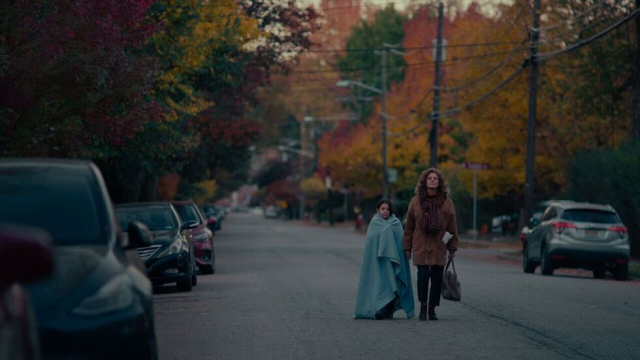
The Accompanist centers on Emily (Everly Carganilla), a young fifth-grader who is unfortunately forced to grow up sooner than expected. She is removed from her grandfather’s (Kevyn Morrow) custody after a harrowing near-death experience on train tracks, an event she reluctantly shares, off-screen, with the school nurse. Child Services arrives at her door in the form of Sarah (Aubrey Plaza), a social worker who sees that Emily is at risk of being harmed. Unfortunately, Sarah panics—essentially kidnapping Emily and taking her to a foster home. When Emily arrives at the door of Sylvia (Susan Sarandon), her life is forever changed.
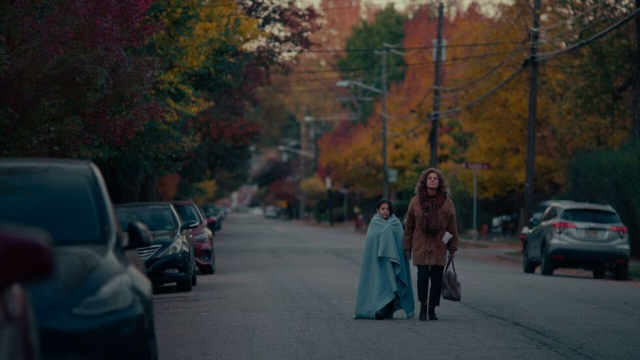
Emily (Everly Carganilla) and Sylvia (Susan Sarandon) in The Accompanist (source: film’s spotlight page for the Tribeca Film Festival).
What I actually want to talk about
In time you will find plenty of reviews that cover The Accompanist’s stellar cast, its focused writing, its whimsical approach to found family that resonates through and despite a gentle sadness.
I don’t want to give a play-by-play of the film’s plot. I don’t want to tell you how Everly Carganilla needs to be nominated for all the awards (and Susan, too). I don’t even want to talk about Zach Woods’s direction, though it was excellent (I say with obvious bias). Folks who know all that can fill you in about the film.
Instead, this review is about Zach Woods’s craft—and about a preoccupation he has been circling, film by film, for years.
When I tell you my jaw dropped about ten or twenty minutes into The Accompanist, it wasn’t from a sensational frame or a line of dialogue. It was when Emily’s grandfather begins to read from Roald Dahl’s The Witches aloud.
The Witches connection
If you are a fan of Zach Woods and find his personal background fascinating, then you are well aware of the beloved children’s book The Witches by Roald Dahl. In The Accompanist, Zach doesn’t explore the loss of innocence. Instead, and more interestingly, he hones in on the idea of being forced to grow up too fast.
In an interview with Jesse Thorn on Bullseye, Zach speaks at length about his adolescence. At sixteen, he commuted from suburban Pennsylvania to New York City to take improv courses at Upright Citizens Brigade—then a grungy underground hub for the weirdos who would become comedy legends. He remarked that his parents treated him and his siblings like “little adults.”
It’s no wonder Zach has been drawn to the subject of little adults. His prior short films, David (2020) and Bud (2021), both deal with children—one a teenage son, the other a daughter freshly turned seven—forced to confront their parents with older eyes.
Emily’s forced maturity in The Accompanist
The Accompanist observes the same tension in Emily. Her grandfather has dementia, but she doesn’t know it—except she does. She recognizes his memory loss, and takes care of him, reminding him to not stay up too late while stargazing and assisting him with his medication. We later see a familiar, loving gesture the two of them share, one that tells us Emily knows she will likely never really see her grandfather again after a hospital visit. The film trusts her to carry that knowledge, the way kids carry things adults assume they can’t.
Emily also has Tourette’s—a detail Woods confirmed at his Luminaries panel at Tribeca’s Storytelling Summit—and the film renders it physically: tics that jerk her head hard to one side. Not anxiety, but the body moving on its own. Woods has spoken publicly about living with OCD and Tourette’s himself. He doesn’t narrate that connection in the film. He simply lets it sit in Emily’s body.
The witch anxiety
On the podcast Take Your Shoes Off with Rick Glassman, after riffing in a comedic bit about the witches of Salem (read: Solemn), Zach explains that he’s had more than one witch in his life:
“I love witches. I’ve always had some version of that again and again and again. So it changed as I grew up—that core anxiety. Are you a witch or am I a witch?”
The Accompanist chronicles that observation. When Emily and her grandfather realized they had survived the train—it was one track over—he scolded her for yelling: a child punished for the sound of her own fear. So Emily, therefore, must be a bad witch. Right?
Good witches and bad witches
In the same podcast, Zach traces that anxiety to its source—a childhood fear that the person he depended on most might also be the one to harm him:
“…if you think about what it’s like to be a kid, and to think that your mother—in some way as loving and nurturing as she is—might actually be a malevolent force—”
Rick stops him with the question the whole film turns on:
“But why is a witch necessarily bad?”
Zach circles the same fear elsewhere in the conversation—that his “most relied upon person” might be “in some way malevolent”—then immediately deadpans his way out of it: “I’m not saying all witches are malevolent—although I do believe that. No, I don’t.” The comic’s reflex, undercutting the confession the instant it lands. The point was never that witches are evil. It’s that the people who shape us hold a power we can’t name when we’re small, and can’t always tell apart from threat.
The Accompanist spends its runtime answering Rick’s question: sorting the witches in Emily’s life into bad and good, then complicating the sort.
Sarah takes Emily away from her grandfather, dramatically giving rushed explanations about how he may be unfit to care for her, insisting that her primary concern is Emily’s safety and wellbeing. Sarah is a bad witch with good intentions. And yet we later see that she turns out to be a good witch: when she realizes after a few weeks that Emily has come to love Sylvia, she does her best to have Sylvia recognize that she can be a mother again.
In another scene, Sylvia massages Emily’s neck and head when a tic takes hold—when her head jerks hard to the side, when the pressure builds and has to go somewhere.
Sylvia gives her access to a piano—and it was a treat for me to quickly confirm what I had hoped months before I attended the premiere: the film’s title is a double entendre. Although Sylvia is Emily’s accompanist as a guardian, she was also the musical accompanist, by piano, for her own daughter, who has passed away from anorexia—a ballerina who held herself to extremely high expectations.
Sylvia gives Emily a TV. Sylvia shows her pictures of her own grandmother from Romania. Sylvia takes her shopping. Sylvia teaches her how to perform a trick utilizing a fork to pierce one of those little creamer cups at a diner, creating a horrifying scene at their table as if she were gouging out her eye. They cackle together, like witches at a cauldron.
Sylvia doesn’t shield her from the realities of being an older adult—she smokes, despite Sarah’s objections and dismay. But despite these habits Sarah dislikes, Emily loves Sylvia. When Sylvia learns this, she lands in freefall: it is her fear of losing another daughter, of becoming a mother again at seventy-eight, that drives the film’s central conflict.
But we know Sylvia loves Emily.
And therefore, Sylvia is a good witch.
Zach-coded moments
Besides the clear connection to The Witches, there are other moments in the film that felt very Zach-coded:
On Harry, the talk show hosted by Harry Connick Jr., Zach, as a guest, spoke about taking lessons from a Wiccan piano teacher: “She was a witch. She used to paint her face white, and on Halloween she would invite her students over and have a Wiccan ceremony.”
Near the beginning of The Accompanist, we see Emily at a roller derby near or on Halloween; fellow skaters are dressed in costumes. Emily’s grandfather is staring off into the distance, clearly not supervising her time on the rink.
And then there’s Emily herself: her face is thinly painted a ghostly white, her eyes hollowed out in deep purple, a small skeleton on skates; a child already dressed as death, long before she’s old enough to understand it.
Later, when Sylvia and Emily shop at a thrift store, they encounter a sweater better fit for a grandma. The sweater in question, fuzzy and cozy and blue, is very similar to an item of apparel Zach has worn constantly:
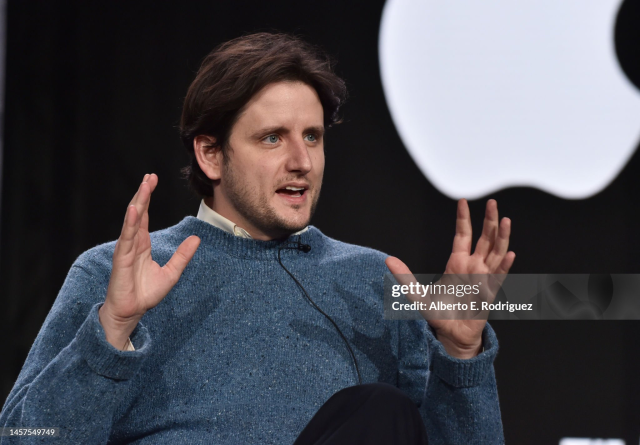
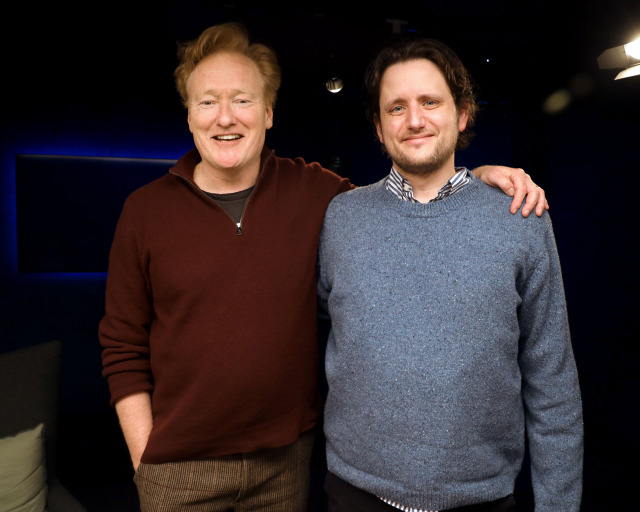
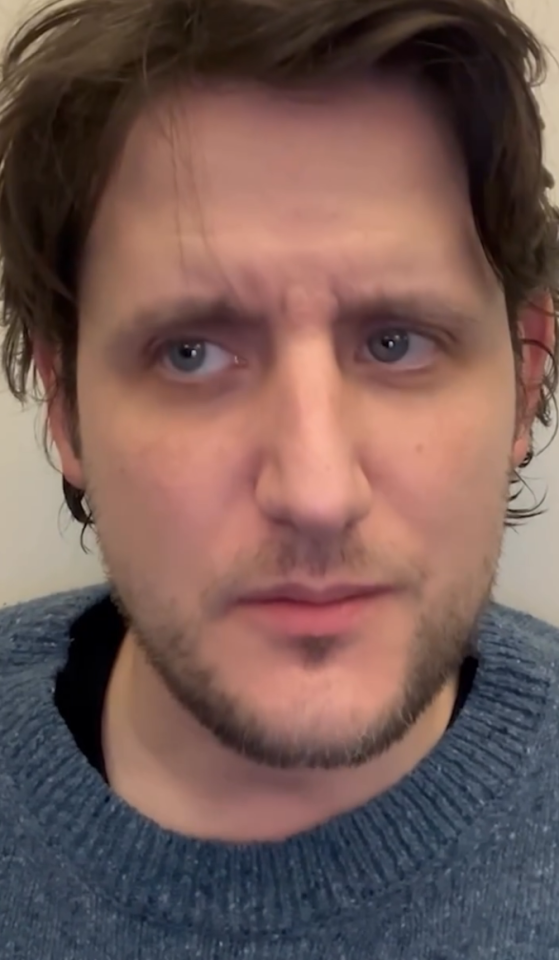

Photos: 2023 AppleTV+ Event for The Afterparty (Getty Images); 2024 promo for Zach’s appearance on Conan O’Brien Needs a Friend (Twitter/X); Zach’s IG reel “Romance Advice for Straight Men” (Instagram); 2025 promo for UCB Austin, highlighting an improv show from 2024 that Zach and writing partner Brandon Gardner participated in together to promote their TV series In the Know (Instagram)
Is Zach hinting at Emily standing in for him as a child? With this woven line of thinking, probably not, to be completely honest—it’s a fun thought because, the bonus? At the scene’s start we can see Zach himself, out of focus in the foreground, perusing the racks for his next sweater.
How he made it: ricocheting the truth off a fictional wall
I asked Woods during the Luminaries panel how he arrived to a place of vulnerability to write and direct something this personal—and how he made his actors feel safe enough to meet him there.
His answer is the key to the whole film. He said he’s slightly ambivalent about being seen in conversation—he’d rather ask questions than answer them—but that a film offers a kind of plausible deniability. “You kind of need to ricochet the truth of your experience off of a fictional wall,” he said, “because throwing it directly feels too…” He paused, thinking. Close, I offered. “Yeah.”
That’s the method. The Accompanist is autobiography thrown at an angle—the truth bounced off Emily, off Sylvia, off a fork in a diner—so it can land without having to be aimed straight at us, or at him.
On directing his actors, he said the safety came from attention. “I think attention is love, often,” he said—if you slow down and don’t treat people as obstacles on the way to your agenda, and really hear what they’re saying, because they’re right a lot, too. He described Susan Sarandon pushing back on his choices, and himself realizing, again and again, that she was right—telling her, it’s irritating, it turns out you know a great deal about storytelling. “People don’t feel safe when they’re rushed,” he said. “I’m not always good at it, but that’s what I try to do.”
The trilogy: a director learning to throw the truth
The Accompanist doesn’t arrive out of nowhere. It is the third film in what now reads as a loose trilogy about children who see their parents—and their world—with adult eyes, before they should have to.
In David (2020), a therapist (Will Ferrell) is so consumed by a patient that he cannot show up for his own son. It is about a parent whose caretaking flows everywhere except home—and at the time, Woods kept the personal material at arm’s length, indicating in interviews only a “familiarity” with the therapist’s office his psychiatrist father worked in.
Bud (2021) steadied the hand. It is the more confident treatment of the same preoccupation—its lens a single child, Madeline, on the occasion of her seventh birthday, brilliantly portrayed by a then-six-year-old Everly Carganilla: the same young actor Woods would cast, five years later, as Emily. Even then, she is looking up at the adults who are supposed to have it together, and finding the cracks.
The Accompanist completes the arc, and not just by going feature-length. Where David held the autobiography at a distance, this film embraces it—Woods telling a room full of strangers, to my face, that it’s personal, and then explaining the very technique he needed in order to make that closeness bearable. The trilogy escalates in scope, short to short to feature. But it also escalates in nerve—not in how directly he aims, but in how much of himself he’s willing to throw at the fictional wall. The fiction is always the wall; what grows, film to film, is the force of the throw, and the trust that the ricochet will carry the truth home.
A celebration of witches
I think this film is a celebration of witches—a celebration of the people who show up in our lives and force us to grow up whether we want to or not. As I mentioned earlier, Zach has encountered many witches in his life: his father, his mother, his white-faced piano teacher, perhaps his improv mentors, perhaps the writing partner he found in Brandon Gardner, people like Mike Judge, Anya Saffri, and Michael Delaney—and the other influential figures who have helped grow his craft.
And the film’s gift is that it doesn’t keep the witches private to him. By the end, they aren’t only his. They’re everyone’s—the people who arrived early, demanded that we see clearly, and changed our lives from the door. The Accompanist asks you to remember yours.
In the words of Zach Woods: “You need your witches, you got to get ‘em, and you got to be them when you can.”
Zach Woods’ feature directorial debut, co-written with Brandon Gardner. World premiere: Tribeca Festival, June 4, 2026.
Runtime: 110 minutes. Starring Susan Sarandon, Everly Carganilla, Aubrey Plaza, and Kevyn Morrow. Written by Brandon Gardner and Zach Woods. Directed by Zach Woods.